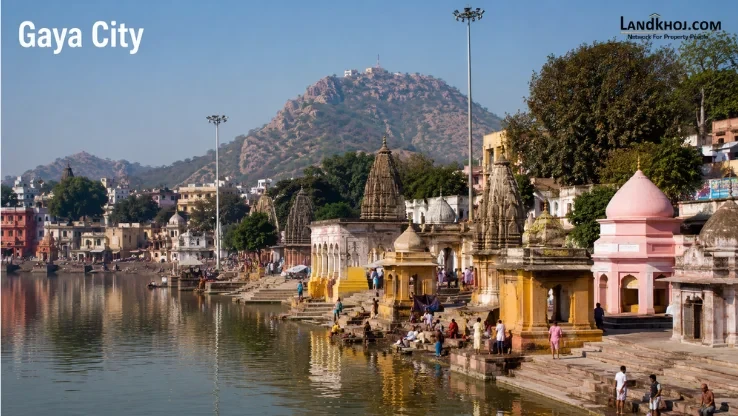
Gaya City
To understand Gaya's property market, you first need to understand that two quite different places are at work here — Gaya and Bodh Gaya. Gaya is an established district centre with a railway junction, hospitals, busy markets, government offices, and a large permanent population. Bodh Gaya has a different character altogether — Buddhist pilgrimage, international monasteries, hotels, and airport-linked travel define it more than anything else. Vishnupad Temple, the Pind Daan season, Gaya Junction, the Falgu River, universities, hospitals, and Gaya Airport — all of these together create very different kinds of need. Some people are interested in finding a home, others are only looking for a guest house, some want a shop, and some are on the lookout for a rental property.
How Gaya and Bodh Gaya Function as Two Connected Property Markets
The two places are very close to each other and people move from one to the other regularly, but what each one can offer is quite different. Families, government employees, traders, and people with railway connections will generally find Gaya more practical for permanent living — markets, hospitals, and offices are all within reach. Bodh Gaya is where you are more likely to find hotel staff, monks, students, and people working in hospitality. So before buying, think clearly about what you intend to do with the property — who will live or work there, what the road access is like, whether parking is workable, and whether the land use is properly approved. Treating both as the same market will lead you in the wrong direction.
Vishnupad Temple, Pind Daan and the Short-Stay Property Economy of Gaya
Vishnupad Temple, the Falgu ghats, and the Pind Daan season keep a certain kind of activity going around this area — dharamshalas, lodges, budget rooms, food stalls, and transport services all have a place here. The number of people increases quite a bit during the major religious seasons, but it is not the same all year round. If you live or have property along pilgrimage routes, you should expect narrow lanes, a lot of people walking all the time, shortage of water and sanitation, almost no parking, and the difficulty of getting a vehicle through, even in an emergency, as is your daily reality. This is not just a seasonal issue — it is the regular experience for people in those neighbourhoods.
How Gaya Airport Shapes Hotels, Rentals and Road-Corridor Property Demand
Gaya Airport has made connectivity around Bodh Gaya noticeably better. Properties along Airport Road and the Gaya–Bodh Gaya Road tend to attract hotel operators, guest house owners, transport businesses, and people looking for staff rentals. Yet, simply being close to the airport is not enough to automatically make a property worth buying. Look into things like actual traffic flow, drainage condition, parking availability, if the permissions for the land use have been properly done, the safety of the road, and also if there are any restrictions on building airport-related structures on that plot.
Living Near the Falgu River and Understanding Seasonal Site Conditions
One cannot consider the Falgu River merely a geographical landmark in Gaya; it is an integral part of the pilgrimage character and dictates how the localities feel and operate. But buying land or a home near the river calls for extra attention. What is the elevation of the plot, is the approach road solid, what is the soil like, where does sewerage go, how does rainwater drain, does the area waterlog — all of this matters. Near the ghats, foot traffic and parking issues come with the territory. A piece of land that seems perfectly fine on a clear day might show a completely different aspect when the monsoon comes. So, if you can, go to the place more than once, at different times of the year. Also, make sure you check the local building and environmental rules before making any decision.
New projects to explore
View all Under Construction
5
Under Construction
5

Adarsh Greens
Kogilu, Bengaluru, Bangalore, Karnataka
Price
₹67 Lac
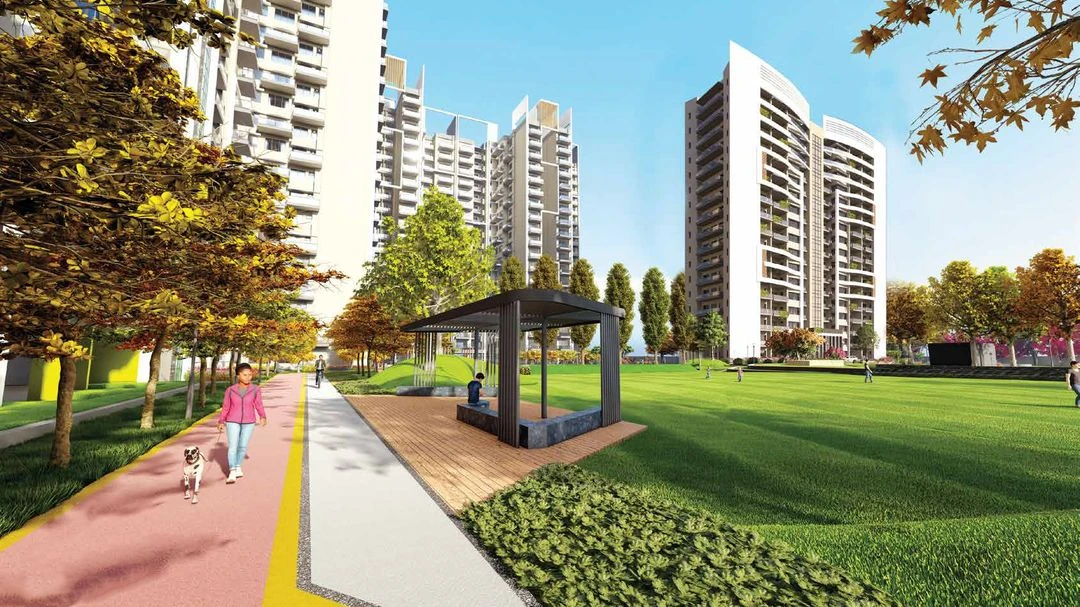 On Going Projects

MANOR ONE
Sector 111, Sector 111, Gurugram
Price
₹1.89 Cr
 Recent Launch
Prestige Pallavaram Gardens
Pallavaram, Chennai, Tamil Nadu
Price
₹1.09 Cr
Properties to explore
View all


Gaya Junction, Station Road and the Property Impact of Regional Passenger Movement
Gaya Junction and Station Road always have something going on — passengers coming and going, shops staying open late, transport running through the day. Hotels, rental rooms, food stalls, transport offices, and mixed-use buildings all find takers here because of that steady movement. Traders, students, workers, visitors — for all of them, being close to the railway makes life easier. But living near all that also means noise, congestion, movement late into the night, parking trouble, and streets that are rarely wide enough. So if you are buying here for the family, do not just weigh the transport convenience — the overall feel of the neighbourhood matters just as much.
How Magadh University, Medical Institutions and Colleges Influence Rental Housing
Magadh University, the colleges around it, and the medical institutions bring in a whole different set of people who need a place to stay — students, teachers, doctors, nurses, office staff, and family members accompanying patients. Private hostels, rental rooms, pharmacies, diagnostic centres, food joints, and local transport all see steady use because of this. But landlords who assume that being near a university or hospital means the room will never sit empty — that assumption needs a second look. The point is, how much time will it take to get to the place, the nice quality of the road, is water supply reliable, does the area seem safe, how frequently tenants change, what is the academic calendar of the institution. Yes, closeness is a plus but it does not tell the entire story.
Choosing Between Old Gaya, Bodh Gaya Road and Expanding Outer Neighbourhoods
Old Gaya has its own character — established markets, pilgrimage-linked activity, familiar services, and properties that have been around for decades. The disadvantage is that the streets are very crowded, the lanes are quite narrow, and there is almost no parking anywhere. The Bodh Gaya Road is the primary road connecting the two cities where the airport, hotels, and several businesses on the roadside are situated in a line. The outer neighbourhoods offer something different — plots, independent houses, quieter streets, and more breathing room. Choosing between these areas should not come down to location alone. Drainage, water supply, distance to schools and hospitals, transport options, whether the layout is approved, and whether land records are clean — put all of this together before making up your mind.
What Buyers Should Check Before Purchasing Pilgrimage-Route or River-Side Property in Gaya
Before buying anything in Gaya, go through the documents carefully. Title history, mutation, encumbrances, plot details, possession, boundary disputes, municipal status, land use, conversion requirements, approved layout, building permission — check each one. Where applicable, verify Bihar RERA registration as well. And do not stop at the paperwork. Go to the site and see for yourself — is there a proper legal access road, how wide is it, is there space to park, where does the drainage and sewerage go, what is the electricity situation, how close is the river, is the plot at a reasonable elevation, does water collect there during the rains, and how crowded does the area get during the Pind Daan season. If someone is telling you that the land will go commercial, that airport growth will push prices up, that rental income will be strong, or that a new road is coming — hear them out, but make your decision only after your own legal checks and a proper visit to the site.
Conclusion
To get a real sense of Gaya's property market, you have to look at Gaya and Bodh Gaya separately — each has its own rhythm. Vishnupad Temple and the Pind Daan season, Gaya Airport, the Falgu River, Gaya Junction, universities, hospitals — each of these shapes demand in its own way. Old Gaya, Bodh Gaya Road, and the outer areas all offer different options, whether you are looking at residential, hospitality, or commercial property. LandKhoj at landkhoj.com can be a useful starting point for research, but whatever you decide in the end should come from your own ground-level verification.
FAQs
Is Gaya City good for buying property?
Yes, Gaya is a good fit for family living trade professionals, students, hospitality operators, and buyers of residential or commercial properties connected to local demand.
Is it better to buy property in Gaya City or Bodh Gaya?
It really depends on what you want to do with it; Gaya might be utilized for permanent housing and local district services Though the main development in Bodh Gaya revolves around pilgrimage, hotel and short-stay activities.
How does Pind Daan and pilgrimage activity affect property demand in Gaya?
This leads to a seasonal requirement for lodges, dharamshalas, rental rooms, shops, food outlets, transport services, and mixed-use properties in the vicinity of pilgrimage routes.
Does Gaya Airport influence nearby hotel and rental demand?
Yes, travel by air often means hotel development, guest houses, short-stay rentals, transport services, and roadside businesses in easily locatable settings.
Is property near the Falgu River suitable for residential use?
One might consider, for instance, checking up elevation drainage waterlogging, access roads, soils condition, sewerage, and construction restrictions before deciding.
Does Gaya Junction create rental and commercial property demand?
Yes, about passenger movement demanding rooms, hotels, shops, food outlets, transport services, and mixed-use buildings near connected areas.
What should buyers verify before purchasing pilgrimage-route or river-side property in Gaya?
A buyer should ask for documents in real estate transactions like title mutation land use approvals access, parking drainage elevation, commercial-use permission, utilities, and seasonal crowd conditions.