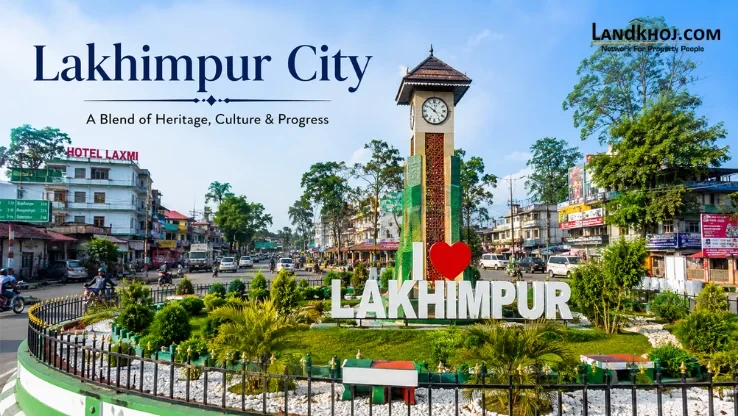
Lakhimpur City
To understand Lakhimpur from a property point of view, it is important to first look at daily life in the city. It is more than just a district headquarters — daily life here revolves around farms, rice mills, local markets, government offices and busy bazaars. People here don't buy property to build an investment portfolio. They buy because they need a home — close to work, close to the kids' school, and close to where everyday things are available. That's what makes the property market here different from bigger cities. That is why it may not be right to compare Lakhimpur with a metro city. Property decisions here are mostly based on real-life needs. Families need convenient areas to live in, traders find spaces near markets useful, and students and employees look at commutes and basic facilities. Because of this, interest in long-term housing and small commercial properties in Lakhimpur stays linked to local needs.
Why is Lakhimpur City important for real estate buyers?
For the villages and smaller towns around Lakhimpur, this city is where things happen — work, shopping, government offices, daily errands. In many ways, it's the central point the whole surrounding area depends on. That is why, while looking at property here, people do not only check the size of the plot or house. They also see how easily they can reach the market, school, hospital, court, government offices, railway station and bus stand from that area. On LandKhoj.com, https://www.landkhoj.com/, Lakhimpur is better presented as a practical city where daily convenience, paperwork, civic facilities, and local work opportunities matter more than a luxury image.
Some offices and institutions in Lakhimpur City directly support the city’s daily functioning
- The Municipal Council's work shows up directly on your street, your drainage line and the road outside your gate — not just on paper. Before you finalise any area, it's worth walking around once. Does water log up during rains? Is the road in decent condition? Is there regular cleaning? These things seem small, but when you're stepping out every morning, they're the first things you notice.
- The District Magistrate Office is also an important part of the city’s identity, as it clearly shows Lakhimpur’s role as a district headquarters. Officials, local people, visitors, and service providers keep coming here for administrative work. This regular movement also affects nearby areas, where there can be scope for rental homes, small offices, shops, and service-based businesses.
How does Lakhimpur’s local economy support property demand?
Property in Lakhimpur is closely connected with the city’s agriculture and local business activity. Sugarcane work, rice mills, mandis, transport services and small businesses keep regular movement in the city. Lakhimpur has farmers, traders, salaried workers and daily wage earners — all living and working here. Everyone's needs are different. That's why areas near the mandi see demand for rental rooms, shop spaces and small godowns alongside regular homes. Where money and movement are higher, the need for both living and working spaces naturally follows. It's straightforward, really.
Key Economic Drivers in Lakhimpur City
- Sugarcane trade plays a strong role in Lakhimpur’s economy. It keeps transport operators, labourers, wholesale traders and local businesses regularly engaged with work. When an area has this kind of daily movement, nearby shops, rental spaces, and small commercial properties also remain useful.
- Rice mills bring regular movement of workers, traders, and small service providers in Lakhimpur. Loading, unloading, and transport work also keep happening around these mills. Because of this kind of activity, people may need rooms or homes nearby, especially in areas close to mills or trade points.
- Grain Mandi is an important centre for agriculture trade in Lakhimpur. Around the mandi, there is usually a need for shops, storage spaces, transport-related work, and affordable housing. This is why nearby areas can be practical for local buyers and small investors.
How is connectivity in Lakhimpur useful for homebuyers?
There's no metro here, so daily travel depends on roadways, buses, the railway, shared autos and private vehicles. The state highway connects Lakhimpur to several important places, and people use it daily to reach offices, markets and nearby towns. Lucknow airport is around 130 km away — fine for occasional travel, but not something you factor into daily life. For practical, everyday commuting, road and rail are what actually matter here.
Key Transport Points in Lakhimpur City
- The railway station's importance here goes beyond just the word "connectivity." Students travelling for studies, traders moving goods, people working in other cities — for all of them, living near the station is a genuine convenience. It saves both time and money on daily or frequent travel, which is why areas around the station tend to attract buyers who have a real reason to use it regularly.
- The bus stand works in a similar way. UP Roadways buses connect Lakhimpur to Lucknow, Sitapur, Shahjahanpur and several nearby towns. For someone who regularly travels for work, studies or business, living close to the bus stand actually makes a practical difference — whether you're a student, a trader or someone with regular government work elsewhere.
- State Highway routes connect Lakhimpur with nearby areas. Good road connectivity helps residential areas with daily travel, gives shops better visibility, and also makes the movement of agricultural products relatively easier.
Why does development planning matter in Lakhimpur?
While looking at property in Lakhimpur, it is not enough to decide only on the basis of location or price. The city’s growth depends a lot on district planning, municipal work, road conditions, drainage, public services and how smoothly land-related offices function. One more thing — when you're looking at a property, don't stop at location and price. Before you finalise any property, run through a few basic checks — are the land records clean, what's the registration status, is the approach road paved or still kutcha, and does the area get waterlogged during rains. All of this needs to be looked at before signing anything.
New projects to explore
View all Possession Started

Saraswati Smart Homes
Noida Phase-2, Noida Phase-2, Noida, Meerut, Uttar Pradesh
Price
₹32 Lac
 Recent Launch
Prestige Pallavaram Gardens
Pallavaram, Chennai, Tamil Nadu
Price
₹1.09 Cr
 Possession Started

Elite X
Sector 10, Noida, Meerut, Uttar Pradesh
Price
₹2.01 Cr
Properties to explore
View all

Key Planning and Documentation Points
- For land and revenue-related work in Lakhimpur, the Tehsil Office plays an important role. When a buyer purchases a property, work like ownership verification, mutation or checking local land records is usually done through the formal process at the Tehsil Office.
- For property registration, the Sub-Registrar Office Lakhimpur is an important place. After buying a house, plot or commercial space, getting the registry done is necessary because it creates a proper legal record of the transaction. To avoid confusion later about ownership, documents or the deal, buyers should not take the registry process lightly. It is one of the main steps in making the property legally secure.
Which residential areas in Lakhimpur are useful for buyers?
When people in Lakhimpur look for a place to live, the first thing on their mind is how easy daily life will be. Is the market nearby, how far is the railway station, where are the schools, how quickly can you get to a hospital, how much running around will government work involve — all of this runs through a buyer's head. A lower rate alone doesn't make a locality good. Drainage, road width, safety after dark, distance from work — everything adds up when someone is making the final call.
Key Residential Areas in Lakhimpur City
- Civil Lines is one of Lakhimpur's better-known areas — part residential, part administrative. For people who want to stay close to offices, schools and civic facilities, it tends to work out well. Whether it's a family or a working professional living alone, basic needs are generally accessible from here without too much effort.
- The biggest thing going for Station Road is that both the railway station and the market are close by. Whether you're a trader, a tenant or someone who commutes regularly, this location genuinely makes daily life easier. Work, travel and everyday needs — all three can be managed without going too far, and that's what makes it convenient for people who live here.
- Nai Basti is one of Lakhimpur's older neighbourhoods. People have been living here for a long time, so there's a settled, familiar feel to it — none of that unfinished, new-colony awkwardness. Neighbours know each other, daily essentials are nearby, and the environment feels established. For buyers who want a locality where things are already in place, Nai Basti is a solid option.
Why is healthcare access important in Lakhimpur real estate?
How far the hospital is — almost every buyer checks this, regardless of age or family situation. It's not just about senior citizens. This isn't only a concern for older residents or large families. Young couples, people with small children, those living alone — if something goes wrong late at night, the first question is always whether there's something nearby. When a clinic or medical shop is within reach, the area genuinely feels safer and more settled to live in.
Key Healthcare Facilities in Lakhimpur City
- District Hospital Lakhimpur is an important public hospital for people in the city. For families, having it nearby means you're not travelling far every time there's a medical need — whether it's a regular check-up or something urgent. When someone at home is on regular medication, or still going for follow-ups after recovering from something, distance starts to matter a lot more. Going far every single time just isn't practical.
- Having a Community Health Centre within the city means you don't have to head to a big hospital for every small thing. Fever, an injection, a routine check-up — these everyday needs are real too. For families who think about these things before finalising a home, a nearby CHC is genuinely useful, not just a checkbox. For families who want basic medical help within reach, knowing that a CHC is nearby does make a difference when they're deciding where to buy or rent.
- Private nursing homes give residents more medical options. For families and elderly residents, having such facilities nearby becomes a plus point because they do not have to go outside the city or travel too far for every treatment.
How do education and infrastructure support housing demand?
The quality of living in Lakhimpur does not depend only on the house or locality. Education and basic infrastructure also matter a lot. Areas around colleges usually have regular movement of students, staff, and families. Because of this, such locations can be practical for living as well as rental use. But while checking a property, buyers should not look only at college access. They should also check the drainage condition, canal system, waterlogging risk, and flood protection, because these factors can affect the land condition and comfort of living in the future.
Key Education and Infrastructure Assets
- Government Girls Degree College Lakhimpur is an important college for women’s higher education in the city. Areas near it can be useful for families who give priority to their daughters’ education and easy access to college. Since students keep coming and going around the college, there can also be a regular need for rental rooms, stationery shops, food points, and daily-use services nearby.
- Government Polytechnic Lakhimpur is considered an important option for technical education in the town. Because of students, faculty members, coaching-related work and other educational services around it, there is regular movement in the locality. Because of this, nearby residential pockets can be practical for students and staff members. This makes nearby residential pockets practical for students and staff members.
- Lakhimpur’s Sharda Canal System and flood protection embankments are important for water management and flood safety. Before finalising a property, buyers should check the drainage condition, waterlogging risk, and the condition of nearby embankments. These points should not be ignored, because later they can decide whether living in that area will be comfortable or whether using the property may become difficult.
Conclusion
Lakhimpur’s property value cannot be understood by looking only at the price of a house or plot. Buyers also need to see how easily markets, schools, colleges, hospitals, and basic facilities can be reached from that area. The city is also closely linked with local infrastructure and agriculture-based trade, so both daily living and local work activity play an important role in property decisions. Lakhimpur’s local economy is closely connected with sugarcane trade, rice mills, mandis, railway connectivity, district offices and old residential areas. Because of this, property here is also used according to real daily needs. While buying a home in this city of Uttar Pradesh, people usually check how easy it will be to live in that area, go to work, commute and manage everyday requirements.
FAQs
1. Is Lakhimpur a good city to buy a house?
Yes, Buying a home in Lakhimpur makes sense if you're thinking about actual day-to-day needs. The market is nearby, schools and hospitals are around, the railway station is accessible, government offices are within reach — regular life here is manageable. This isn't a metro city, so people here think less about investment angles and more about what works for them practically. Comfort, location and everyday convenience are what drive most decisions here.
2. Which are good areas to live in Lakhimpur?
Civil Lines, Station Road and Nai Basti are three different areas with three different things going for them. Civil Lines tends to work better for people who have regular dealings with offices or government work. Station Road has a straightforward advantage — the railway station and market are both close. Nai Basti suits those who'd rather skip the new-colony uncertainty and settle into a neighbourhood that's already found its feet — where people have lived for years and familiar faces are part of daily life.
3. What should I check before buying property in Lakhimpur?
A good rate catches the eye, but rate alone doesn't make a property worth buying — everything else needs to check out first. Are the documents clean? Is ownership clear, no disputes? Has registration been done? Is the road paved or does it sink in the rains? Does water drain out or collect? And also — how far are the school, hospital, station and bus stand? At the time of buying, all this feels secondary. Once you're living there, these are the first things that come to mind.
4. Is Station Road Area good for buying property in Lakhimpur?
Station Road can work well for people who don't want the railway station or market too far from home — traders, students, office-goers, or anyone who's regularly travelling somewhere. That's the straightforward advantage of the location. But before finalising anything here, visit the lane yourself. Check the traffic, how noisy it gets, where you'd park, what condition the road is in. These things don't show up in photos — you have to go and see.
5. Does Lakhimpur have good transport connectivity?
Lakhimpur doesn't have metro connectivity, and that's straightforward. Daily travel here runs on roadways, buses, the railway, shared autos and personal vehicles. The state highway connects the city to several important places. Lucknow airport is around 130 km away — fine for occasional travel, but not part of anyone's daily routine. For regular commuting, road and rail are what practically matter here.
6. Is Lakhimpur good for rental property?
Rental property in Lakhimpur tends to work in areas where people are moving around regularly — near the station, bus stand, college, mandi or busy work areas. Rental rooms, small houses and shop spaces are in demand in these pockets. But actual rental value will depend on exactly where the property is and how much daily activity is around it — broad assumptions don't work here.
7. Why do people buy property in Lakhimpur?
Most people buying property in Lakhimpur have a genuine, everyday need behind it — there's no big plan involved. For a family, it usually starts with finding a home near a school, hospital and market. Traders want to be close to the mandi, a transport point or a busy commercial stretch. For salaried people, commute time, road condition and basic facilities weigh heavily in the decision. It all adds up differently for different buyers.
8. Is healthcare access important while buying a home in Lakhimpur?
Yes, When looking for a home, almost every buyer thinks about hospital access at some point. It doesn't matter if you're a young couple or have elderly family members at home — the question comes up. Being able to reach District Hospital Lakhimpur or a nearby health centre without much effort gives families a certain peace of mind. In an emergency, not having to travel far is a small thing that feels very big when it actually happens.