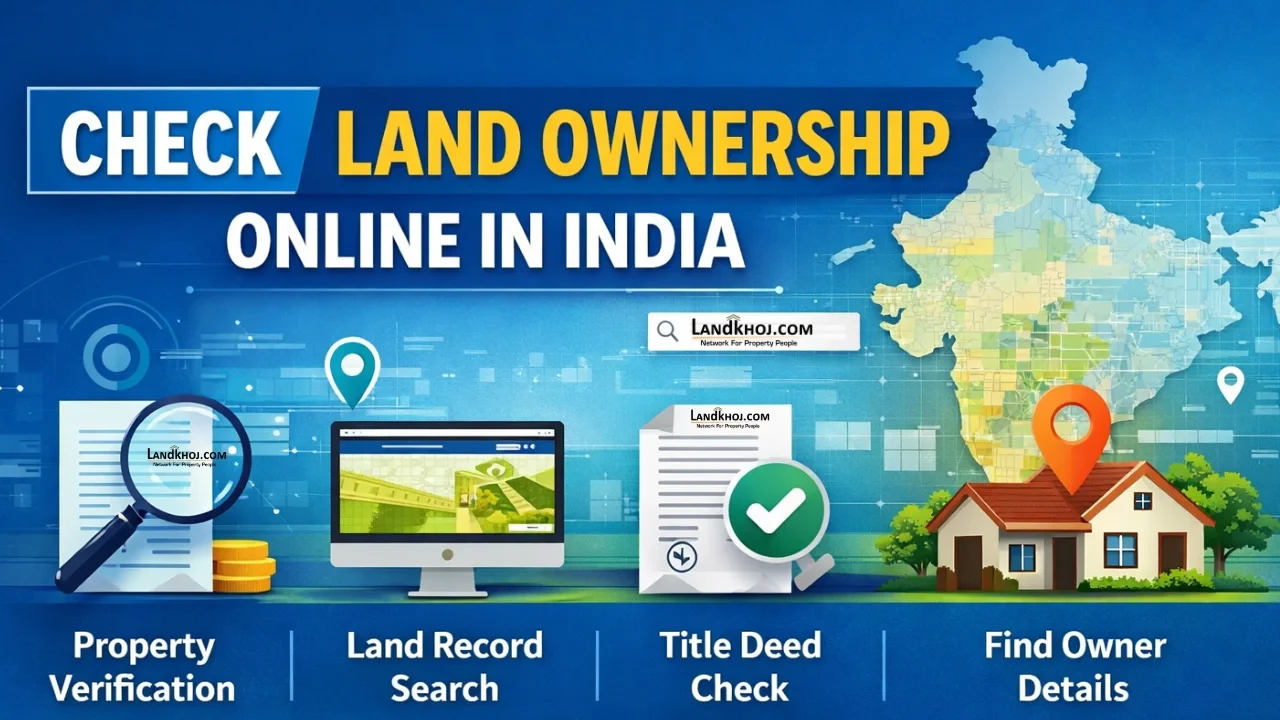
How to Check Land Ownership Online in India
Table of Contents
- Introduction
- Why Property Verification Matters
- How to Check Land Ownership Online
- Property Verification Online (Step-by-Step)
- Land Record Search by Name
- Land Document Verification Basics
Introduction
Buying land or property in India is one of the biggest financial decisions a person makes, and honestly, it’s not something you want to take lightly. While the internet has made it easier to access information, it has also created confusion because not all data is clear or reliable. Many buyers assume that if something is listed online, it must be correct—but that’s not always true. This is exactly why understanding how to verify property ownership properly is so important. Platforms like Landkhoj are helping simplify this process by giving users structured and easy-to-understand property data. Whether you're planning to invest, buy a house, or just verify ownership, having the right guidance can save you from serious financial and legal trouble.
Why Property Verification Matters
Property verification is not just a step—it’s the most important step in any real estate transaction. In India, property disputes are very common due to unclear ownership records, illegal sales, or incomplete documentation. Many buyers trust brokers or sellers without doing independent verification, which often leads to future complications. Proper verification ensures that the person selling the property actually has the legal right to do so and that the land is free from disputes or loans. When you go through a proper property verification online process, you can check ownership history, pending liabilities, and legal status. Using a reliable platform like Landkhoj adds an extra layer of security because it organizes scattered data into something you can actually understand and trust.
🔹 Key Benefits:
- Protects you from fraud
- Confirms legal ownership
- Helps avoid future disputes
- Ensures safe investment decisions
How to Check Land Ownership Online
If you want to check land ownership online, the process is actually simpler than most people think—but only if you follow the right steps. In India, most state governments have digitized their land records, which means you can access ownership details through official portals without visiting a government office. To begin, you typically need basic information like the survey number, khasra number, or sometimes even the owner's name. Once you enter these details, the system will display ownership information, land type, and mutation status. However, the challenge is that every state portal looks different and can be confusing to navigate. This is where Landkhoj becomes useful, as it simplifies the process and presents all the important data in one place without unnecessary complexity.
🔹 Steps to Follow:
- Visit the official land record website
- Enter correct property details
- Review ownership information carefully
- Cross-check data with multiple sources
Property Verification Online – Step-by-Step
Doing property verification online properly requires more than just checking one record. A lot of people make the mistake of stopping after seeing the owner’s name, but that’s only the beginning. A complete verification process includes checking ownership records, encumbrance details, registration data, and land use classification. Each of these elements plays an important role in determining whether the property is safe to purchase. You also need to ensure that there are no legal disputes or unpaid loans attached to the land. Platforms like Landkhoj help streamline this process by combining multiple verification steps into a single workflow, making it easier for users to get a complete picture without missing anything important.
🔹 Steps to Follow:
- Check ownership details
- Verify encumbrance certificate
- Confirm land usage type
- Validate registration records
Land Record Search by Name
In many cases, buyers do not have access to technical details like survey numbers or khasra numbers, which is where land record search by name becomes extremely useful. This method allows users to find property records using the name of the owner, making the search process more accessible. However, it’s important to understand that not all states in India fully support this feature, and even where it is available, the results may not always be accurate or complete. That’s why it’s recommended to use this method as a starting point rather than a final verification step. Tools like Landkhoj enhance this process by using smarter search filters, helping users find relevant results even when the available information is limited or slightly incorrect.
🔹 Important Points:
- Useful when survey number is unknown
- Results may vary by state
- Should be cross-verified
- Works better with additional details
Land Document Verification Basics
Land document verification is one of the most critical parts of the entire property checking process, and skipping this step can lead to serious consequences. When verifying documents, you need to carefully examine the sale deed, title deed, encumbrance certificate, and property tax receipts. Each of these documents provides different insights into the property's legal status and ownership history. For example, the sale deed confirms the transfer of ownership, while the encumbrance certificate shows whether there are any loans or liabilities attached to the property. Many buyers overlook small details in these documents, which later turn into big problems. Using platforms like Landkhoj can help ensure that all documents are properly reviewed and validated before making any final decision.
🔹 Checklist:
- Verify sale deed authenticity
- Check title ownership
- Review encumbrance certificate
- Confirm tax payment records
Advanced Methods for Property Search & Ownership Verification (By Landkhoj)
Property Deed Search by Name Free Methods
When people start researching property ownership, one of the most common things they look for is a property deed search by name free option. It sounds simple—just enter a name and get ownership details—but in reality, it’s a bit more complicated. In India, some state registration portals allow users to search for registered deeds using the owner’s name, but the results are often limited. You may get partial information such as registration number, date, or location, but not always complete ownership details. That’s why relying only on free sources can sometimes lead to incomplete understanding. Platforms like Landkhoj help bridge this gap by combining multiple data points and presenting a clearer picture, so you don’t have to depend on scattered or partial records.
🔹 Key Points:
- Free searches often provide limited data
- Not all states support name-based deed search
- Results may require manual verification
- Better to cross-check with reliable platforms like Landkhoj
Free Land Registry Search by Name – What You Should Know
The idea of doing a free land registry search by name is appealing, especially for first-time buyers who want quick access to ownership data. However, it’s important to understand the limitations of free registry systems. Most government portals provide basic access to land records, but detailed registry information—such as transaction history or ownership changes—may not always be fully accessible. In many cases, the data is outdated or requires additional filters to get accurate results. This creates confusion for users who assume they are seeing complete information. That’s why experts recommend using structured platforms like Landkhoj, which organize and verify registry data so users can make informed decisions without relying on incomplete or misleading information.
New projects to explore
View all On Going Projects

MANOR ONE
Sector 111, Sector 111, Gurugram
Price
₹1.89 Cr
 Under Construction

Hamsa Evara
Jagatpura, Jaipur, Jaipur, Rajasthan
Price
₹31.36 Lac
 Ready to Move

Aadhar Elite Prime
Vaishali Nagar, Jaipur, Jaipur, Rajasthan
Price
₹45.36 Lac
Properties to explore
View all
🔹 Reality Check:
- Free registry data is often incomplete
- Detailed records may require deeper verification
- Data accuracy depends on state updates
- Always cross-check before making decisions
Find House Owner Name by Address – Is It Reliable?
Many users try to find house owner name by address, especially when they only know the location of a property but not the owner’s details. While this is possible in some cases, it is not always straightforward. In urban areas, municipal records, property tax databases, and utility records can sometimes be used to identify the owner. However, access to this information may be restricted due to privacy policies or incomplete digital records. In rural or semi-urban areas, the process can be even more challenging due to lack of digitization. This is where platforms like Landkhoj can help by connecting different data sources and making it easier to retrieve ownership details without going through multiple confusing systems.
🔹 Possible Methods:
- Municipal property tax records
- Online land record portals
- Local authority verification
- Digital tools like Landkhoj
Land Registry Search by Name: Government Systems Explained
A land registry search by name is one of the most commonly used methods for checking property ownership through government systems. Each state in India has its own registry portal where users can search for land records using different parameters, including owner name. These systems are designed to improve transparency, but they can often be difficult to navigate, especially for first-time users. The interface, terminology, and data structure vary from state to state, which adds to the confusion. While these portals are reliable sources of information, they require patience and understanding to use effectively. Platforms like Landkhoj simplify this entire experience by providing a unified interface where users can access and interpret registry data more easily.
🔹 Common Sources:
- State land record portals
- Registration department websites
- Digital India initiatives
- Aggregated platforms like Landkhoj
Challenges in Online Property Search (Real Insight)
While online systems have made property verification easier, they are not without challenges. One of the biggest issues users face is inconsistent data across different portals. Sometimes, the same property may show different details on different platforms, which creates confusion and doubt. Another challenge is the lack of standardization in how information is presented, making it difficult for users to interpret the data correctly. In addition, many portals require specific inputs like survey numbers, which users may not always have. These challenges highlight the importance of using structured platforms like Landkhoj that simplify data and reduce the chances of misinterpretation, helping users make more confident decisions.
🔹 Common Problems:
- Inconsistent data across portals
- Complex user interfaces
- Missing or outdated records
- Difficulty in understanding legal terms
Search Property by Owner Name – Legal and Practical Approach
Many users try to search property by owner name because it feels like the easiest way to find ownership details. And yes, in some cases, it works—but only if you use the right and legal sources. Government portals do allow name-based searches in certain states, but the results can be limited or require additional filters like district or registration year. The main issue is that common names can generate multiple results, making it difficult to identify the correct property. That’s why relying only on name-based search is not enough. A smarter approach is to combine this method with additional details and use structured platforms like Landkhoj, which help narrow down results and provide more accurate insights without confusion.
🔹 Best Practices:
- Use full name instead of partial name
- Add location filters for better accuracy
- Cross-check with survey or registry data
- Avoid relying on a single source
Find Property by Owner Name Using Digital Tools
If you want to find property by owner name, modern digital tools have made the process much more efficient compared to traditional methods. Instead of visiting multiple offices or searching manually, you can now use integrated platforms that pull data from different sources and present it in one place. However, not all tools are equally reliable, and many free tools may provide outdated or incomplete information. That’s why it’s important to use platforms like Landkhoj, which focus on accuracy and structured data presentation. These tools not only save time but also reduce the chances of missing important details, making the entire property search process smoother and more reliable for users.
🔹 Advantages:
- Saves time and effort
- Provides centralized data access
- Reduces manual errors
- Improves search accuracy
Deep Property Verification: What Most Buyers Miss
Most buyers think verification is just about checking the owner’s name—but that’s only the surface. Real property verification goes much deeper. You need to analyze ownership history, check if the property has been sold multiple times, and verify whether there are any legal disputes or financial liabilities attached. Many fraud cases happen because buyers skip these deeper checks. For example, a property might be legally owned by someone, but still have a pending loan or court case. This is why a detailed verification process is critical. Platforms like Landkhoj help users go beyond basic checks and access deeper insights that are often missed in traditional verification methods.
🔹 What to Check:
- Ownership history
- Previous transactions
- Legal disputes or court cases
- Loan or mortgage status
Understanding Encumbrance and Legal Status
One of the most important yet ignored aspects of property verification is understanding the encumbrance status. An encumbrance refers to any legal or financial liability attached to the property, such as a loan, mortgage, or legal dispute. If you buy a property without checking this, you may end up inheriting someone else’s debt or legal problem. The encumbrance certificate is the key document that provides this information. However, interpreting this document is not always easy for first-time buyers. That’s why it’s important to carefully review all entries and cross-check them with official records. Platforms like Landkhoj simplify this process by helping users understand encumbrance data in a more user-friendly way.
🔹 Key Insights:
- Shows loans or liabilities on property
- Helps avoid legal risks
- Must be checked before purchase
- Requires careful interpretation
Common Mistakes Buyers Make During Verification
Even with so much information available online, many buyers still make avoidable mistakes during property verification. One of the biggest mistakes is relying on a single source of information without cross-checking. Another common error is ignoring small inconsistencies in documents, which can later turn into major issues. Some buyers also skip legal verification to save time or money, which can be a costly decision in the long run. Understanding these mistakes is important so you can avoid them. Using a structured and reliable platform like Landkhoj helps reduce these risks by guiding users through a more complete and accurate verification process.
🔹 Common Errors:
- Trusting incomplete data
- Skipping document verification
- Ignoring legal checks
- Not consulting reliable sources
Why Smart Buyers Use Platforms Like Landkhoj
Smart buyers today don’t rely only on traditional methods—they use digital tools to make better decisions. Platforms like Landkhoj are designed to simplify property verification by combining multiple data sources into one easy-to-use system. Instead of jumping between different government websites and trying to understand complex records, users can get a clearer and more structured view of property data. This not only saves time but also improves accuracy. In a market where small mistakes can lead to big losses, using a reliable platform is not just helpful—it’s essential. That’s why more and more buyers are choosing smarter ways to verify property before investing.
🔹 Why It Matters:
- Simplifies complex data
- Saves time and effort
- Improves decision-making
- Reduces risk of fraud
Advanced Tips for Safe Property Verification
If you really want to stay ahead and avoid costly mistakes, basic verification is not enough—you need to think like a smart investor. Always remember that property verification is not a one-step process; it’s a combination of multiple checks done together. One of the best strategies is to verify the same property using at least two or three different sources to ensure consistency. Also, try to understand the history of the land, not just the current ownership. Many issues are hidden in past transactions that people often ignore. Using platforms like Landkhoj helps simplify this process, but your awareness and attention to detail still play a major role in making a safe and confident decision.
🔹 Pro Tips:
- Always cross-check data from multiple sources
- Never rely on verbal confirmation
- Review complete ownership history
- Take professional advice if needed
How Landkhoj Simplifies the Entire Process
Let’s be honest—most people don’t have the time or expertise to go through multiple government portals and understand legal documents. That’s exactly why platforms like Landkhoj are becoming increasingly popular. Instead of making users jump between different systems, Landkhoj brings everything into one place and presents it in a simple, structured format. This reduces confusion and helps users focus on what actually matters—making the right decision. Whether you want to verify ownership, check documents, or analyze property history, Landkhoj makes the process faster and more user-friendly. In a market where accuracy is everything, having a reliable tool can make a huge difference.
Key Benefits:
- Centralized property data
- Easy-to-understand interface
- Faster verification process
- Better decision-making support
Frequently Asked Questions
-
How can I check land ownership online in India?
You can check land ownership online by visiting your state’s official land record portal and entering details like survey number, khasra number, or owner name. These portals provide ownership records, but they can sometimes be difficult to understand. Platforms like Landkhoj simplify this process by presenting clear and structured property data. Always cross-check information from multiple sources before making any decision.
-
Is property verification online reliable?
Yes, property verification online is reliable when done through official government portals or trusted platforms. However, relying on a single source may lead to incomplete information. A proper verification process includes checking ownership records, encumbrance details, and legal status. Using platforms like Landkhoj helps ensure that all important aspects are covered and the data is easier to understand.
-
Can I search property by owner name in India?
Yes, you can search property by owner name in many Indian states, but the availability depends on the specific state portal. Name-based searches can sometimes return multiple results, especially if the name is common. It is recommended to use additional filters like location or registration details. Platforms like Landkhoj make this process more accurate by offering better filtering and structured search results.
-
Is free land registry search by name accurate?
Free land registry searches can provide basic information, but they are often incomplete or outdated. While they are useful for initial research, they should not be relied upon for final verification. For accurate results, it is important to cross-check multiple sources or use platforms like Landkhoj that combine and verify data from different systems.
-
What documents should I verify before buying property?
Before buying any property, you should verify important documents such as the sale deed, title deed, encumbrance certificate, and property tax receipts. These documents confirm ownership and legal status. Missing any of these checks can lead to serious legal issues later. Using platforms like Landkhoj can help ensure that all documents are properly reviewed and nothing important is overlooked.