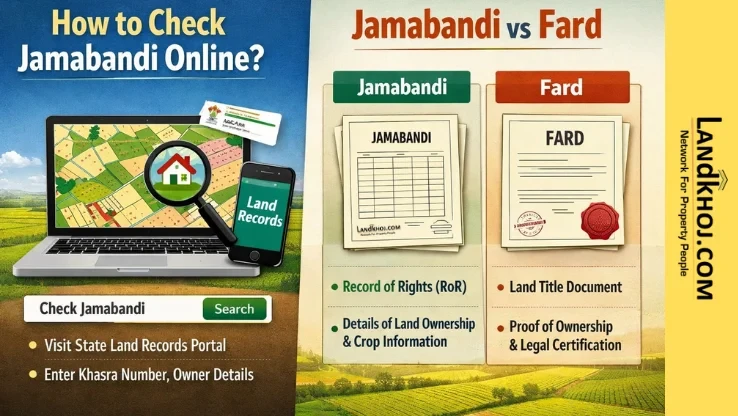
You Know About : How to Check Jamabandi Online?
Index Table
| No. | Questions Covered |
|---|---|
| 1 | How to Check Jamabandi Online? |
| 2 | What is Jamabandi HALRIS? |
| 3 | What is the Difference Between Jamabandi and Fard? |
| 4 | What is Jamabandi Khasra Number? |
| 5 | What is Jamabandi Bhulekh? |
1. How to Check Jamabandi Online?
Checking Jamabandi online has become extremely simple due to the digitization of land records across India. Most state governments provide dedicated portals where users can access Jamabandi records by entering basic details such as district, tehsil, village, or khasra number. This process eliminates the need to visit government offices physically and ensures faster verification of land ownership. Whether you are a buyer, seller, or investor, using online Jamabandi check tools helps you confirm the authenticity of land records instantly. It also reduces the risk of fraud and ensures transparency in property transactions. Always make sure you are using official government portals to avoid incorrect or outdated information.
Steps to Check Jamabandi Online:
- Visit the official Jamabandi portal of your state
- Select district, tehsil, and village
- Choose search method (owner name / khasra number / khata number)
- Enter required details carefully
- Click on search to view the record
- Download or print the Jamabandi copy
2. What is Jamabandi HALRIS?
Jamabandi HALRIS stands for Haryana Land Records Information System, which is a digital platform developed by the Haryana government to modernize land record management. This system allows users to access Jamabandi records, mutation details, and property ownership information online. HALRIS has significantly improved transparency and efficiency in land administration by reducing manual errors and delays. It also integrates multiple land-related services into a single platform, making it easier for citizens to access accurate and updated information. With HALRIS, users can track changes in ownership and ensure that land records are properly maintained.
New projects to explore
View all Under Construction

Golf Island
Sector 10 Dwarka, Sector 19, Delhi, Delhi, Delhi
Price
₹6 Cr
 Possession Started

Saraswati Smart Homes
Noida Phase-2, Noida Phase-2, Noida, Meerut, Uttar Pradesh
Price
₹32 Lac
 Under Construction

Abhinandan Krishna Kunj Phase 1
Tonk Road, Jaipur, Jaipur, Rajasthan
Properties to explore
View all

Key Features of HALRIS:
- Online access to Jamabandi records
- Mutation status tracking
- Accurate and updated land data
- Reduced paperwork and delays
- Improved transparency in land management
3. What is the Difference Between Jamabandi and Fard?
Jamabandi and Fard are often confused, but they serve different purposes in land record management. Jamabandi is a comprehensive and permanent land record, while Fard is a temporary extract or copy of Jamabandi used for quick reference. Jamabandi contains detailed information about ownership, cultivation, and revenue, whereas Fard provides a summarized version of this data. In legal terms, Jamabandi holds more authority and is considered a primary record, while Fard is mainly used for verification purposes during transactions. Understanding this difference is important for anyone dealing with land or property in India.
Key Differences:
- Jamabandi is a complete record; Fard is a copy
- Jamabandi is permanent; Fard is temporary
- Jamabandi has detailed data; Fard is summarized
- Jamabandi is used legally; Fard is used for reference
- Jamabandi is maintained officially; Fard is issued on demand
4. What is Jamabandi Khasra Number?
The Jamabandi Khasra number is a unique identification number assigned to a specific piece of land. It helps in identifying the exact location and boundaries of a land parcel within a village or area. This number is crucial for accessing Jamabandi records online, as it allows users to retrieve precise land details without confusion. Khasra numbers are especially important in rural and agricultural areas, where land is divided into multiple parcels. By using the Jamabandi Khasra number, authorities and individuals can easily track ownership, usage, and revenue details of a particular land segment.
Importance of Khasra Number:
- Unique identification of land parcels
- Helps in accurate record retrieval
- Essential for property transactions
- Used in legal and government processes
- Prevents confusion between similar land plots
5. What is Jamabandi Bhulekh?
Jamabandi Bhulekh refers to the digital version of traditional land records available online through government portals. It allows citizens to access land ownership details without visiting revenue offices. The term “Bhulekh” generally means land records, and when combined with Jamabandi, it represents a modern system of maintaining and accessing these records digitally. This system has revolutionized land management in India by improving accessibility, reducing corruption, and ensuring that records are updated regularly. Jamabandi Bhulekh is especially useful for buyers, investors, and farmers who need quick access to verified land information.
Features of Jamabandi Bhulekh:
- Available online 24/7
- Easy access from anywhere
- Reduces dependency on government offices
- Ensures transparency and accuracy
- Supports digital India initiatives
Conclusion
Understanding Jamabandi, its online access process, and related concepts like HALRIS, Bhulekh, and Fard is essential for anyone dealing with land in India. With digitization, checking Jamabandi has become faster, more transparent, and more reliable. Whether you are buying property, applying for a loan, or verifying ownership, Jamabandi remains the most important document for ensuring legal clarity and security.
-
What documents are required to check Jamabandi online?
You typically need details like district, tehsil, village name, and either the khasra number, khata number, or owner name.
-
Can Jamabandi be used in court as legal proof?
Yes, Jamabandi is a valid legal document and can be used as evidence in land-related disputes.
-
How often is Jamabandi updated?
Jamabandi records are usually updated every 4–5 years or after any ownership mutation.
-
Is Jamabandi required for home loans?
Yes, banks require Jamabandi records to verify land ownership before approving loans.