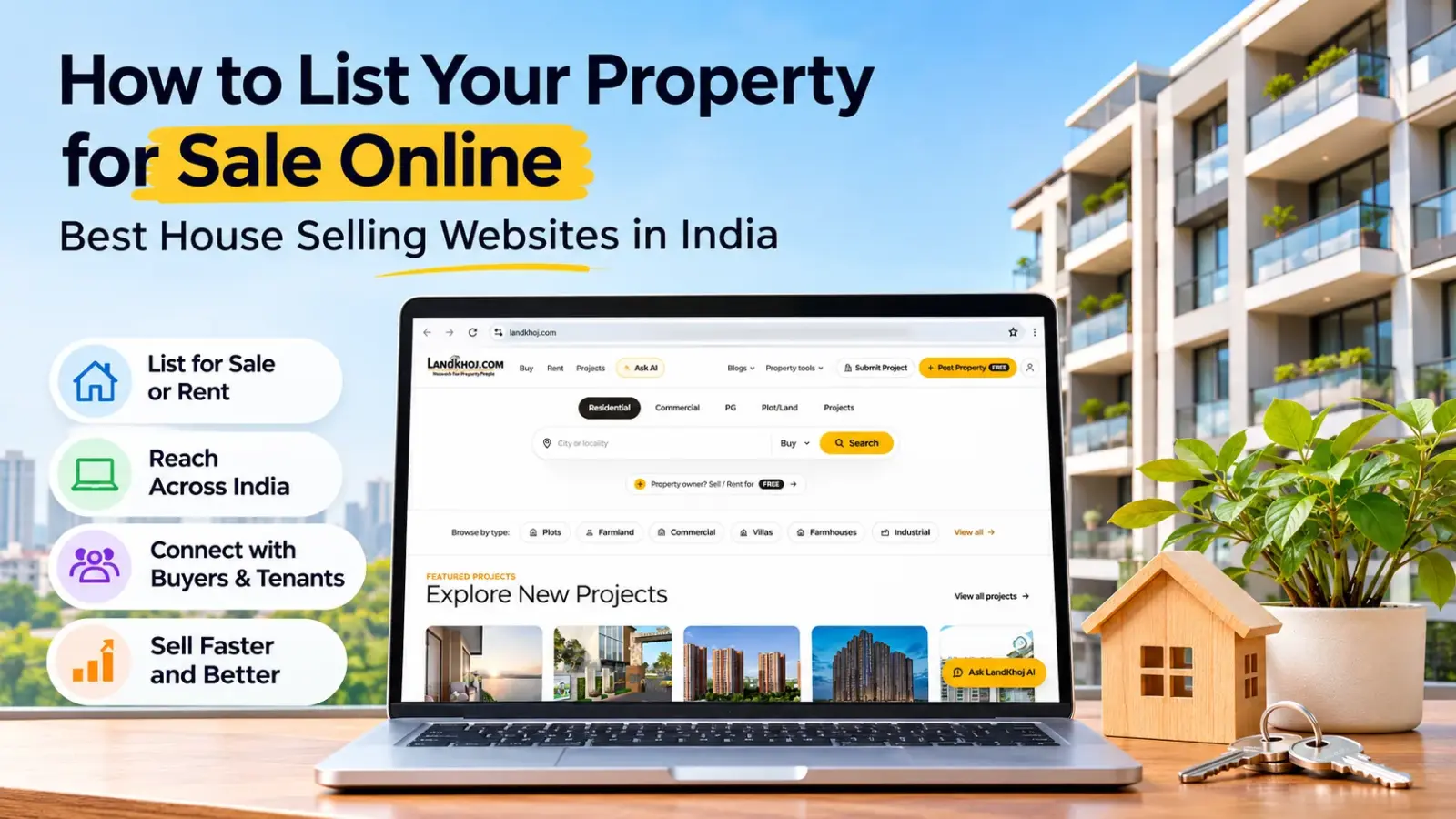
Selling a property involves more than deciding its price and finding a potential buyer. Property owners need to prepare accurate information, present their property effectively, choose suitable online platforms, respond to enquiries, and complete the legal formalities involved in a transaction.
Today, online property platforms have changed how people buy, sell, and rent residential and commercial properties. Instead of depending entirely on local brokers or newspaper advertisements, property owners can reach people searching for homes in different locations.
Whether you want to sell an apartment, advertise an independent house, rent out a flat, or find a suitable property, understanding how online property listings work can help you make better decisions.
This guide by Landkhoj explains how to list your property online, compare house selling websites, evaluate property listing portals, attract genuine buyers, and understand the important precautions involved in online property transactions in India.
Why Should You List Your Property Online?
Listing a property online allows owners to make property information accessible to people actively searching for residential, commercial, or land opportunities.
Traditional property-selling methods often depend on local networks, brokers, and physical advertisements. Online listings provide another way to introduce a property to a wider audience.
The main benefits include:
- Wider visibility among potential buyers and tenants.
- Convenience in creating and updating advertisements.
- Better presentation through property photographs and descriptions.
- Location-based property searches.
- Opportunities for direct communication with interested buyers.
- Easier comparison with similar properties in the market.
Example: Suppose an owner wants to sell a two-bedroom apartment in Greater Noida. Instead of depending only on local contacts, the owner publishes an online advertisement with the apartment's location, area, photographs, and asking price. A buyer relocating from Delhi can discover the property and enquire without initially visiting it.
How Do Property Listing Websites Help Sellers?
A property listing website acts as an online platform where property owners, agents, and developers can publish property information.
If you want to list your property online, first prepare the property's essential information, including its location, category, area, price, photographs, and availability.
Depending on the platform, property advertisements may include:
- Residential apartments and flats.
- Independent houses and villas.
- Residential plots and agricultural land.
- Commercial offices and shops.
- Rental apartments and independent houses.
- Industrial and commercial properties.
Example: An owner selling a residential plot in Jaipur can publish its location, dimensions, land category, asking price, and relevant ownership information. Buyers searching for land in that locality can then assess whether the advertisement matches their requirements.
Why Are Online Platforms Useful for Property Buyers?
Online property platforms help buyers compare available properties according to their budget, preferred location, property type, and requirements.
Useful search filters include city, locality, property price, number of bedrooms, property area, furnishing status, and construction status.
Example: A family searching for a three-bedroom apartment in Pune can compare multiple neighbourhoods before deciding which properties deserve a physical inspection.
How to List Your Property for Sale Online?
If you want to list property for sale, start by collecting accurate property information and selecting platforms that serve your target location.
A properly prepared advertisement makes it easier for buyers to understand what you are offering and decide whether they want to enquire.
1. Choose the Right Property Listing Website
The first step is selecting a suitable property listing website.
Not every platform has the same audience, geographical coverage, property categories, or listing policies. Some focus on residential properties, while others also support commercial properties and land.
Before choosing a platform, evaluate:
- Whether it supports your property category.
- Whether it covers your city and locality.
- Whether individual owners can publish advertisements.
- Whether free and paid listing options are available.
- Whether photographs and detailed descriptions are supported.
- Whether it provides enquiry management features.
For example, individual property owners can explore Landkhoj's property posting facility when looking for a place to publish their property information.
Example: An owner selling agricultural land near Jaipur should select a platform that supports land listings instead of relying exclusively on websites focused on urban apartments.
2. Create an Account and Add Property Details
After selecting a platform, register according to its account requirements.
Prepare the following information:
- Property category.
- Sale or rental status.
- City and locality.
- Property area and measurement unit.
- Number of bedrooms and bathrooms, where applicable.
- Floor number and total building floors.
- Furnishing status.
- Construction age.
- Parking availability.
- Asking price.
- Possession or availability status.
Always distinguish between carpet area, built-up area, and super built-up area.
Example: An owner listing an apartment in Noida should clearly mention whether the advertised area is carpet area or super built-up area to prevent confusion among potential buyers.
3. Upload High-Quality Property Photos
Photographs help potential buyers understand the property's actual condition and layout.
Consider uploading clear photographs of:
- Main entrance.
- Living room.
- Bedrooms.
- Kitchen.
- Bathrooms.
- Balcony or terrace.
- Parking area.
- Building exterior.
Use natural lighting where possible and avoid excessive editing.
Example: An owner selling a furnished apartment in Bengaluru can upload separate photographs of the living room, kitchen, bedrooms, and balcony so buyers can understand the available space.
4. Set the Right Selling Price
Pricing is one of the most important decisions when you want to sell my property online.
Examine comparable properties, recent transactions where reliable information is available, property condition, carpet area, location, building age, and amenities.
Circle rates and government guidance values should not automatically be treated as actual market selling prices.
Example: If comparable apartments are advertised between ₹65 lakh and ₹72 lakh, an owner should compare their area, condition, parking, and location before selecting an asking price.
5. Publish Your Property Listing
Before publishing, review the advertisement carefully.
Check the asking price, area, address, property category, photographs, and contact information. Also review the platform's listing policies.
Property owners who want to publish a property advertisement on Landkhoj can use the property submission page to begin the listing process, subject to the website's applicable requirements.
Example: Before publishing an independent house listing in Lucknow, the owner checks that the photographs belong to the advertised property and that the stated land area matches the available ownership documents.
Best Websites to Sell Property Online in India
Choosing among the available house selling websites requires understanding what each platform offers.
A website may have strong coverage in metropolitan cities but limited listings in smaller towns. Another may offer useful rental filters but fewer features for commercial property owners.
There is no universally best platform for every property seller. The right choice depends on property category, location, audience, pricing, and listing requirements.
What Makes the Best Site to Sell Property?
The best site to sell property should provide a useful combination of visibility, relevant search filters, enquiry management, and transparent listing policies.
| Evaluation factor | What to check |
|---|---|
| Location coverage | Does it support your city and locality? |
| Property categories | Can you list your property type? |
| Listing charges | Are free and paid options available? |
| Search filters | Can buyers find relevant properties? |
| Photographs | Are multiple images supported? |
| Enquiry management | Can owners review enquiries? |
| Privacy | How is personal information handled? |
| Moderation | Are misleading listings addressed? |
Example: An owner selling a commercial office in Delhi should prioritise platforms with commercial property categories rather than choosing a website solely because it is popular for residential apartments.
Features to Look for in House Selling Websites
Before selecting a platform, examine its practical features.
Useful features include owner-based advertisements, residential and commercial categories, locality-based searches, price filters, photographs, enquiry facilities, listing-editing options, and transparent charges.
Example: A seller listing a villa in Hyderabad may benefit from a platform that supports detailed descriptions, multiple photographs, location filters, and buyer enquiries.
How to Choose the Best Website for Selling Property?
Instead of publishing advertisements everywhere, identify platforms that match your property's location and category.
Shortlist relevant platforms, compare their listing conditions, examine similar advertisements, and monitor the quality of enquiries.
Example: A property owner in Faridabad compares three platforms by examining similar residential listings, advertisement charges, and enquiry features. The owner chooses the websites that offer a relevant audience rather than simply selecting the most expensive advertising package.
Top Property Listing Websites and Portals for Buyers and Sellers
India has several established online real estate platforms. Their services, categories, charges, and coverage can change, so users should review current terms before publishing advertisements.
| Platform | General focus |
|---|---|
| 99acres | Residential and commercial property searches |
| Magicbricks | Buying, selling, and rental searches |
| Housing.com | Residential property discovery |
| NoBroker | Property searches and owner-oriented services |
| OLX | Classified advertisements, including property categories where supported |
These are examples, not a verified ranking of current performance.
Popular Real Estate Listing Websites
Real estate listing websites allow users to explore property advertisements through online search tools.
When comparing platforms, examine listing coverage, property categories, owner-posted advertisements, description quality, search filters, and contact arrangements.
Example: A buyer searching for a residential plot in Gurugram can compare advertisements across multiple platforms and then independently verify the plot's sector, land-use status, dimensions, and ownership information.
Best Property Selling Sites
The best property selling sites are not necessarily the platforms with the highest overall website traffic.
For sellers, relevant enquiries matter more than general visitor numbers.
Compare platforms based on property category, geographical coverage, advertisement charges, buyer search behaviour, and enquiry quality.
Example: A person selling a warehouse near an industrial area should consider platforms with commercial and industrial property coverage rather than relying only on residential house selling sites.
Free Ad Posting Sites Real Estate: What Should You Check?
Many owners search for free ad posting sites real estate because they want to advertise without paying upfront listing charges.
However, free advertising does not always mean every feature is available without payment.
Before publishing, check:
- Whether basic property advertisements are free.
- Whether the free listing has a validity period.
- Whether there are limits on photographs.
- Whether premium placement is optional.
- Whether contact details are visible.
- Whether duplicate advertisements are permitted.
Example: An owner advertising a one-bedroom flat in Ghaziabad finds a platform offering free basic advertisements. Before registering, the owner checks whether responding to buyer enquiries requires a paid subscription.
Online Property Sale Websites: How Do They Differ?
Online property sale websites may support different transaction types and property categories.
Some primarily connect buyers and sellers, while others offer additional services.
It is important to distinguish between an advertisement platform and a transaction facilitator. Publishing an advertisement does not mean that the platform has verified ownership or guaranteed a transaction.
Example: A buyer discovers a property through an online advertisement and contacts the owner. Before paying a token amount, the buyer independently verifies the seller's identity, ownership documents, approvals, and transaction conditions.
How to List Your Property for Rent Online?
Selling is not the only reason owners use online listing platforms. Owners with vacant apartments, independent houses, shops, and commercial spaces may also want to find tenants.
If you want to list your property for rent, prepare a clear advertisement that explains the property's features, rent, deposit, location, and availability.
Steps to List Your Property for Rent
Follow these steps:
- Select a website that supports rental advertisements.
- Register as an owner or an appropriate account category.
- Select the property type and rental category.
- Enter the location and property size.
- Mention monthly rent and security deposit.
- Describe furnishing and amenities.
- Upload recent photographs.
- Mention availability and relevant occupancy conditions.
- Review the advertisement before publishing.
Example: An owner renting a two-bedroom apartment in Pune mentions the monthly rent, security deposit, furnishing status, parking availability, and preferred lease conditions.
Tips to Attract Genuine Tenants
A rental advertisement should provide enough information for tenants to make an informed decision.
Mention the monthly rent, security deposit, maintenance charges, furnishing, parking, lease duration, and availability.
Example: A landlord listing a furnished apartment in Noida mentions that the monthly rent is ₹22,000 and maintenance charges are separate. This allows tenants to understand the likely recurring expense before scheduling a visit.
Documents Required for Rental Property Listings
Property owners should keep relevant ownership records, identity documents where required, property tax information, and society permissions where applicable.
A rental agreement should clearly define rent, deposit, duration, maintenance responsibilities, and notice period.
Example: Before renting out a flat in Maharashtra, an owner checks the applicable state requirements for leave-and-licence documentation and registration.
How to Sell My Property Faster Online?
Property owners often want to sell quickly. However, the time required depends on pricing, condition, location, market demand, documentation, and buyer requirements.
Set a Competitive Property Price
Research comparable properties before deciding on an asking price.
Example: An owner selling a three-bedroom apartment in Noida compares similar properties advertised between ₹95 lakh and ₹1.05 crore and examines the differences in area, condition, and parking before setting a realistic price.
Write an Attractive Property Description
Include property type, location, carpet area, bedrooms, floor, parking, amenities, condition, asking price, and possession status.
Example: Instead of writing "Luxury flat at the best location," write: "Three-bedroom apartment with two bathrooms, covered parking, balcony, and approximately 1,250 sq. ft. super built-up area in Sector 78, Noida."
Respond Quickly to Buyer Enquiries
Answer questions honestly, confirm availability, share additional photographs when appropriate, and arrange visits at mutually convenient times.
Example: A buyer enquiring about an independent house in Jaipur asks about parking and price negotiation. The seller provides accurate information and schedules a visit.
Keep Property Documents Ready
Depending on the property, prepare registered sale deeds, previous title documents, property tax receipts, approved building plans, occupancy certificates, society documents, and lender-related records where applicable.
Example: A seller with an outstanding home loan discusses the lender's loan closure and document release process before finalising the transaction.
Property Owners and Real Estate Developers: Understanding Different Listing Requirements
Individual property advertisements and complete real estate project submissions serve different purposes.
An individual owner generally wants to advertise a specific apartment, house, plot, shop, or rental property. A developer may want to provide information about an entire residential or commercial project.
How Can Individual Property Owners Publish Their Listings?
Individual owners should select the appropriate property category and provide the details of the specific property they intend to sell or rent.
For example, owners advertising flats, independent houses, residential plots, shops, or rental properties can explore the Landkhoj property submission page.
The advertisement should clearly identify the property type, location, area, price, availability, and relevant photographs.
Example: An individual owner selling a residential plot in Lucknow should submit the plot's dimensions, locality, asking price, and other relevant property details rather than presenting it as an entire real estate development.
How Can Builders and Developers Submit Real Estate Projects?
Builders and developers have different information requirements from individual property owners.
A complete project submission may involve project-level details such as:
- Project name.
- Developer information.
- Project location.
- Residential or commercial category.
- Available unit configurations.
- Project size.
- Construction status.
- Possession details.
- Relevant approvals and registration information.
- Project photographs and supporting material.
Developers interested in submitting a residential or commercial real estate project can refer to Landkhoj's dedicated project submission page.
Information should be accurate and consistent with applicable project approvals and regulatory disclosures.
Example: A developer introducing a residential project in Greater Noida may need to provide project-level information, available apartment configurations, location details, construction status, and applicable RERA registration information. This is different from an individual owner advertising one apartment within the project.
Property Listing vs Project Submission: What Is the Difference?
| Particular | Individual property listing | Project submission |
|---|---|---|
| Intended user | Individual owners and relevant advertisers | Builders and developers |
| Listing subject | Specific house, flat, plot, or shop | Complete real estate project |
| Property information | Area, price, location, photographs | Project details, developer, units, approvals |
| Main purpose | Advertise an individual property | Present a residential or commercial development |
| Relevant Landkhoj page | Post Property | Submit Project |
Example: An owner selling one apartment in a residential society should use the individual property listing route. The developer responsible for the entire residential project should use the project submission route, subject to the respective website requirements.
Best Websites for Home Buyers and Property Seekers
Online property platforms are useful not only for owners advertising properties but also for people searching for homes, apartments, plots, and rental accommodation.
Best Home Buying Sites
The best home buying sites are those that provide relevant property information and useful search filters.
Buyers should compare location, asking price, carpet area, construction status, photographs, developer details, and applicable project registration information.
Example: A first-time homebuyer comparing apartments in Bengaluru uses multiple websites to shortlist properties and independently verifies the project registration, approved plans, payment schedule, and possession documents.
Popular Home Search Sites
Home search sites allow users to discover properties according to their budget, location, and preferred property type.
A useful search strategy includes selecting the city, shortlisting localities, setting a realistic budget, comparing carpet areas, and checking building information.
Example: A professional searching for a rental apartment in Gurgaon filters results according to office commute, monthly rent, furnishing, and public transport access.
House Finding Websites
House finding websites can help buyers and tenants identify properties in different neighbourhoods.
However, users should not rely exclusively on photographs or advertised descriptions. Verify the actual location, connectivity, water supply, electricity, maintenance, ownership, and legal information.
Example: A family finds a house advertised near a Delhi metro station and physically checks the walking distance, surrounding roads, and parking availability.
House Searching Websites: What Should Buyers Compare?
Buyers should compare carpet area, building age, floor, parking, maintenance, location, and legal documents instead of looking only at the headline asking price.
Example: Two apartments are advertised at ₹80 lakh. One offers a larger carpet area but higher maintenance, while the other is closer to the buyer's workplace. Comparing the complete details helps the buyer make an informed decision.
Home Buying Website: What Should You Look For?
A useful home buying website should provide clear photographs, accurate location information, detailed property descriptions, updated availability, transparent asking prices, search filters, and privacy information.
Example: Before visiting a property, a buyer contacts the advertiser to confirm that it is still available and that the asking price has not changed.
Important Safety Checks Before Buying or Selling Property Online
Online advertisements can simplify the search process, but they do not replace legal due diligence.
Buyers and sellers should take reasonable precautions before sharing documents, paying money, or signing agreements.
Verify Property Ownership
Buyers should establish that the person offering the property has the legal authority to sell it.
Relevant checks may involve registered sale deeds, ownership chains, land records, encumbrance information, co-owner consent, inheritance documents, and lender rights.
Example: A buyer purchasing inherited property in Haryana asks for succession documents and obtains legal assistance to verify that all necessary owners have consented.
Check RERA Registration Where Applicable
The Real Estate (Regulation and Development) Act, 2016 provides a regulatory framework for covered real estate projects and agents.
For applicable projects, buyers should check the relevant state RERA authority for registration details, project information, approvals, and disclosed timelines.
Example: A buyer considering an under-construction apartment in Uttar Pradesh searches the UP RERA portal for the project's registration details and compares the information with the developer's advertisement.
Understand Circle Rates and Property Registration
Circle rates, also known by different state-specific names, are government-notified reference values used for relevant property-related purposes.
Stamp duty and registration charges depend on applicable state rules and transaction details.
Example: A buyer purchasing a property in Delhi checks the prevailing valuation requirements and stamp duty before calculating the complete purchase cost.
Avoid Property Listing and Payment Scams
Be cautious of unusually low prices, demands for advance payments before inspection, refusal to provide basic ownership information, pressure to transfer money immediately, and requests for OTPs or banking credentials.
Example: An advertiser offers an apartment significantly below comparable market prices and demands a refundable booking amount before allowing an inspection. The buyer refuses to transfer money and independently verifies the property.
Conclusion
Listing a property online can help owners reach a wider audience and make buying, selling, and renting more convenient. However, choosing the right platform is only one part of a successful property transaction.
Accurate property details, realistic pricing, clear photographs, timely communication, and proper documentation all contribute to a better experience for buyers and sellers.
People searching for house selling websites, property selling sites, or home buying sites should compare platform features rather than relying solely on popularity or advertising claims.
Individual property owners looking to advertise a flat, house, plot, or rental property can refer to the Landkhoj property submission page. Builders and developers looking to provide information about complete residential or commercial developments can refer to the Landkhoj project submission page.
Landkhoj publishes informational real estate content to help readers understand property-related processes, online property searches, and important considerations involved in buying, selling, and renting real estate in India. Making informed decisions begins with accurate information and careful verification.
Frequently Asked Questions About Online Property Listings
1. How can I list my property for sale online in India?
To list your property for sale online, choose a suitable real estate platform, create an account, select the property category, and provide accurate details such as location, area, price, and property condition. Upload recent photographs and publish the advertisement after reviewing all information.
2. Which is the best website to sell property in India?
The best website depends on your property type, location, target buyers, and listing requirements. Platforms such as 99acres, Magicbricks, Housing.com, and NoBroker can be compared based on location coverage, listing charges, search features, and enquiry quality.
3. Can I list my property for free?
Some property listing websites offer free basic advertisements, while others charge for publishing or premium visibility. Free listing conditions may include restrictions on advertisement duration, photographs, or the number of active properties. Always review current pricing and terms.
4. Where can I find free ad posting sites for real estate?
You can explore property categories on real estate portals and classified advertising platforms. Before publishing, check whether basic advertisements are free, whether the platform supports your property category, and whether additional charges apply to enquiries or premium placement.
5. How can I sell my property faster online?
To improve your chances of selling faster, set a realistic asking price, upload clear photographs, provide accurate property details, respond promptly to enquiries, and keep ownership documents ready. The selling period also depends on location, property condition, market demand, and buyer affordability.
6. Which websites are best for finding houses in India?
Buyers can compare platforms such as 99acres, Magicbricks, Housing.com, and NoBroker. The suitability of each website depends on the city, property category, available listings, search filters, and information quality. Always inspect the property and verify its documents independently.
7. How do I list my property for rent online?
Choose a platform that supports rental advertisements and create an owner account where available. Add the property's location, monthly rent, security deposit, furnishing status, photographs, and availability. Review the advertisement carefully before publishing.
8. What details should I include in a property listing?
A property advertisement should include the property type, location, carpet area, asking price, number of bedrooms, bathrooms, furnishing status, parking, photographs, and possession or rental availability. Accurate information helps potential buyers and tenants assess whether the property meets their requirements.
9. Are house selling websites safe to use?
Established platforms may provide moderation, reporting, and account security features, but an online advertisement does not guarantee that a property or advertiser is genuine. Verify the seller's identity, property ownership, and documents before making payments or signing agreements.
10. What is the difference between a property listing website and a property listing portal?
Both terms generally describe online platforms where property information is published and searched. A property listing portal may provide additional search filters, enquiry management, account features, and other real estate information. The actual difference depends on the services offered by the individual platform.
11. Can I sell my property without a real estate agent?
Yes. Property owners can advertise their properties directly on platforms that allow owner listings. However, they must manage enquiries, property visits, negotiations, documentation, and transaction formalities themselves. Professional legal assistance may be useful when checking ownership and completing the sale.
12. How should I decide the selling price of my house?
Compare similar properties in the same locality, considering carpet area, building condition, age, amenities, parking, and recent transaction evidence. Government circle rates can provide a reference for certain purposes, but they do not necessarily represent the actual market selling price.
13. What photographs should I upload when listing a house?
Upload recent, clear photographs of the entrance, living room, bedrooms, kitchen, bathrooms, balconies, and building exterior. Include parking and relevant common facilities where appropriate. Photographs should accurately represent the property's present condition.
14. Which documents should I prepare before selling a property?
Depending on the property, relevant documents may include the registered sale deed, previous title documents, property tax receipts, approved building plans, occupancy or completion certificates, encumbrance information, and society documents. Requirements vary by property type and state.
15. Can I advertise agricultural land on property selling sites?
Some real estate listing websites support agricultural land and plot advertisements, while others focus mainly on residential and commercial properties. Before publishing, check the platform's property categories and understand applicable land-use, ownership, and transfer restrictions.
16. What is the difference between carpet area and built-up area?
Carpet area refers to the net usable floor area within the apartment's internal walls, subject to the applicable statutory definition. Built-up area generally includes the carpet area and additional structural areas such as walls. Buyers should check the stated measurement and applicable legal definitions.
17. How can buyers verify a property advertised online?
Buyers should inspect the property, verify the seller's identity, examine title documents, check relevant land records, review applicable approvals, and investigate outstanding loans or encumbrances. For applicable registered real estate projects, buyers should also check the relevant state RERA portal.
18. Do property listing websites guarantee a buyer?
No. Publishing an advertisement does not guarantee that a buyer will contact the owner or complete a transaction. The outcome depends on property pricing, location, condition, market demand, advertisement quality, and buyer requirements.
19. Is it better to use one property listing website or multiple websites?
Using multiple relevant platforms can increase the potential audience for a property. However, owners should keep advertisements consistent, update availability, avoid prohibited duplicate listings, and monitor enquiry quality rather than publishing the same advertisement indiscriminately.
20. What should I check before paying a property booking amount?
Before paying, verify the seller's authority, property ownership, relevant approvals, agreed price, payment terms, refund conditions, and proposed agreement. For developer projects, check applicable RERA information. Make payments through documented channels and obtain proper receipts.
21. How can tenants identify genuine rental properties online?
Tenants should confirm the property's location, inspect it physically, verify the landlord's authority, understand the rent and security deposit, and review the rental agreement. Avoid transferring deposits to unknown people before establishing the property's authenticity and occupancy terms.
22. Are online home buying sites useful for first-time buyers?
Yes. Online home buying sites help first-time buyers compare locations, prices, property sizes, and available amenities. However, online information should be treated as an initial research resource. Buyers should conduct independent legal, financial, and physical checks before committing to a purchase.